
Why Most Study Schedules Fail
Aspirants often build a schedule that looks like this: 5 AM wake-up, 2 hours newspaper, 3 hours Maths, 2 hours GK, 1 hour Reasoning, 2 hours revision. It works for 3 days. Then life happens — a wedding, a bad night's sleep, a power cut. The schedule collapses, and guilt takes over.
The problem isn't discipline. The problem is the schedule was designed for a robot, not a human.
Principle 1: Time Blocks, Not Hour Counts
 📸 Illustration — Productivity
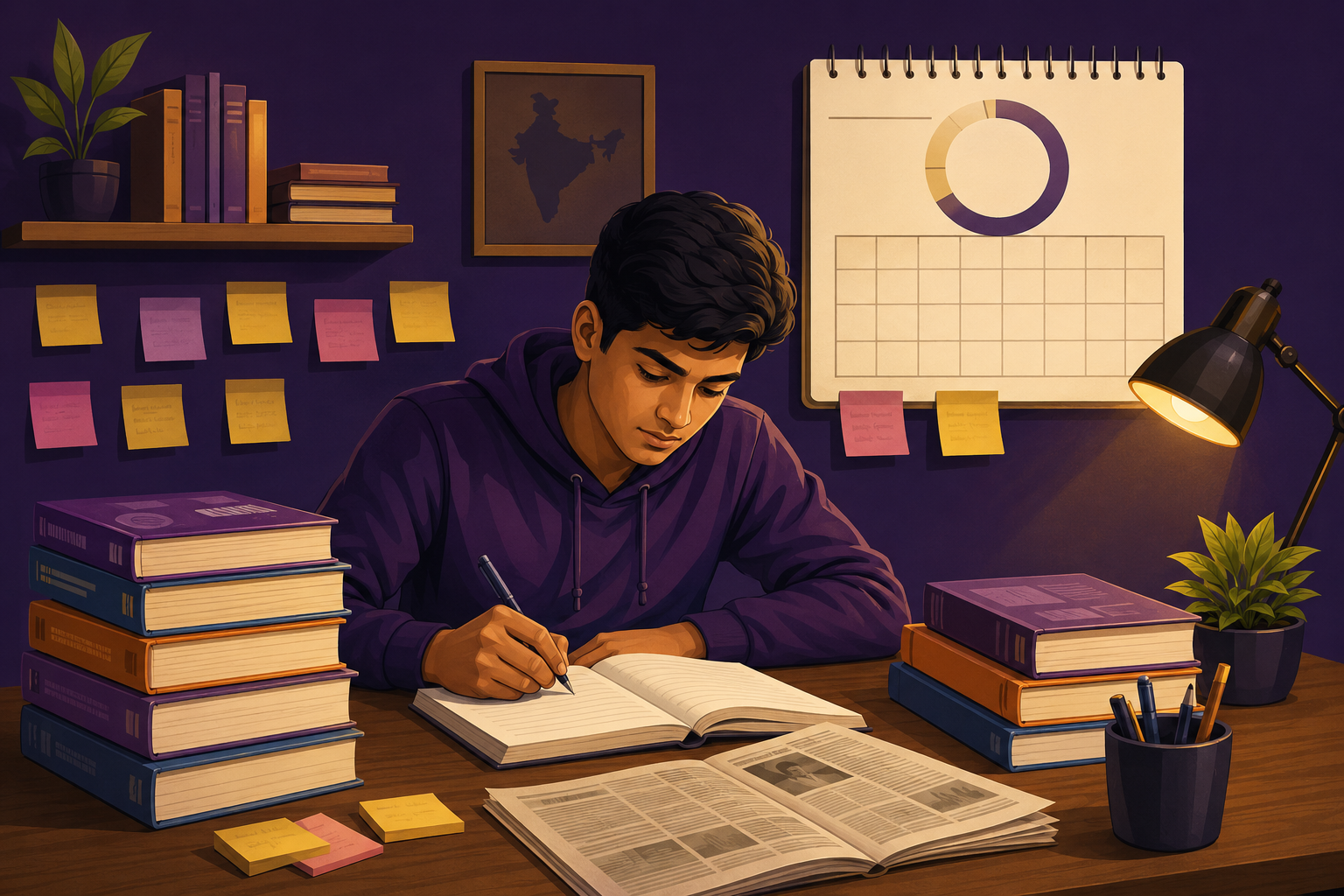
Instead of saying "I will study 8 hours today", commit to 3 study blocks of 90 minutes each. Research shows the human brain can focus deeply for 90 minutes before needing a break. A 20-minute break between blocks restores full concentration.
3 blocks × 90 minutes = 4.5 hours of quality study beats 8 hours of distracted study every time.
Principle 2: Match Subject to Energy Level
- Morning (high energy): Quantitative Aptitude, Reasoning — subjects requiring active problem-solving
- Afternoon (medium energy): GK, Current Affairs, History — reading and memorisation
- Evening (lower energy): English — vocabulary revision, reading comprehension, light practice
Never schedule your hardest subject when your energy is lowest. This is why "I'll do Maths at night" almost never works.
The Weekly Template (Working Professional Version)
 📸 Illustration — Productivity
- Monday: Quant (1 topic in depth) + 30 mins GK
- Tuesday: Reasoning (1 topic) + 30 mins English vocab
- Wednesday: GK / Current Affairs (1.5 hours) + 30 mins Quant revision
- Thursday: English (grammar + comprehension) + 30 mins Reasoning revision
- Friday: PYQ practice (mixed — 50 questions) + review errors
- Saturday: Full-length sectional mock (2 hours) + detailed analysis
- Sunday: Light revision only — notes, GK, no new topics. Rest is mandatory.
The 80/20 Rule for Study Topics
In every subject, 20% of the topics contribute to 80% of exam questions. For SSC CGL Quant, those topics are: Percentage, Profit & Loss, SI/CI, Time & Work, Speed & Distance, Ratio, and Geometry. Master these first before touching advanced topics.
Tracking Progress Without Overwhelming Yourself
- Keep a simple checklist: topic covered ✓, practised ✓, revised ✓
- Weekly mock score tracking — plot it on a graph (even in a notebook)
- Monthly assessment: which topics are still below 70% accuracy?
For Students with College / Jobs
You don't need 8 hours. 3 focused hours daily + 1 full day on weekends is enough to crack most competitive exams in 9–12 months. The key is consistency over intensity. Studying 2 hours daily for 365 days = 730 hours. Most toppers needed 600–900 hours of actual study time.
Start small. Build the habit first. The hours will follow. 📅